Recently, my video updates have been a bit slow over the past two days, mainly because AI technology has made significant progress. I need to take time to test the latest large models’ capabilities in coding, drawing, voice, and more to ensure I don’t fall behind. Based on the test results, the progress of AI is still very obvious. Although I still maintain the view that AI is currently just a tool and has little to do with intelligence, the speed of progress for this tool has indeed exceeded my expectations. I will share specific insights on the Void Hunzi channel. In this video, I want to talk about the AI competition between China and the United States, as well as how other countries around the world are responding to this AI revolution.
Today, OpenAI released GPT 5.2. In fact, Cursor could already call it through API last night. I personally tested it, and there is improvement compared to GPT 5.1, but compared to Claude’s Opus 4.5, I think there is a clear gap. I originally planned to temporarily release a video predicting that OpenAI would definitely hype its new model crazily, then release some scores and test examples that are particularly favorable to it. I am 100% confident it would do this, because Google’s Gemini 3 Pro ended OpenAI’s leading advantage. OpenAI urgently needs to regain the high ground of public opinion, because it has not yet gone public and has not achieved profitability. In the future, it needs more money to develop the next generation of models. If it falls behind Google technically, its grand story will become worthless, and investors will not continue to invest.
However, last night I was still tinkering with local AI model tests and got too tired, so I had to give up. After getting up, I found that, as expected, news about GPT 5.2 was overwhelming. The media influence of the industry leader is still very strong. I quickly scanned the media information again and summarized that OpenAI is increasingly relying on product promotion rather than product strength. Just like when Sora was released, I clearly said in the video that this thing is commercial fraud with no practicality. Most of the functions it promotes are impossible to be practical, and no company would use such industrial garbage to improve productivity. Later, it released Sora 2, focusing on various short videos and even challenging TikTok. I also clearly said in the video that AI generated video cannot break through the fundamental contradiction between long duration and consistency from a technical perspective. This is an algorithmic problem. Generating 10 second videos has a novelty feel in the short term, but it cannot produce real value. Audiences will soon lose the novelty and even get tired of such content. What does it use to challenge TikTok? Once it enters a production environment, the electricity costs for generating videos are extremely astonishing, not to mention the cost of the chips themselves.
Yes, the development of large models is already difficult to solve by investing more computing power and building larger computing centers. AGI will not arrive in the short term. We need to get used to resisting the bragging and fraud of these leading AI companies, but I must also admit that AI’s applications in programming, image generation, voice, documents, data retrieval, and other aspects are becoming more accurate, especially in programming, where it can already replace most junior programmers. However, AI can still only do very lightweight program design, and only for projects with simple and clear function definitions and flexible expression methods. It is still far from replacing senior programmers and architects.
From the actual capabilities of large models, American commercial models such as GPT, Gemini, Opus, and Grok are undoubtedly leading the world, but Chinese open source models like DeepSeek and Qwen, as well as Chinese commercial models like Doubao and PanGu, do not have a large gap with top models. You will not gain obvious productivity advantages by spending 10 times or even 100 times the money to use American AI. On the contrary, because AI cannot avoid hallucinations and cannot be fully trusted, in your workflow, small changes often require regenerating large chunks of content. When capabilities are similar, price is very important. It can even be said that in complex project development, price is hundreds of times more important than the slight capability gap of top models. The advantage of Chinese models is providing 90% performance at 1/10 the price. If the United States wants to completely crush Chinese competitors in the field of AI large models, the cost may be far more than 10 times.
Currently, the United States leads China by a lot in advanced chip processes, which also establishes the computing power advantage of American companies over Chinese companies. But this situation will be rapidly narrowed in the next few years, because China’s DUV, EUV, multiple exposure, and other technologies have moved from laboratories to production lines. The time left for Americans is running out. The Kirin 9030 Pro chip used in Huawei Mate 80 phone, paired with HarmonyOS 6 operating system, has reached the level of Android flagship phones in actual user experience. It was highly recognized by the market after release and sold very well. China is currently building more than 10 nuclear power plants and has taken the lead in launching thorium based molten salt reactors. It is also leading the world in nuclear fusion power generation technology. Currently, China’s power generation is twice that of the United States and equals the total of the second to fifth places. In 10 years, this gap may become even more terrifying. When China’s chip technology breaks through and the number of computing centers surpasses the United States, it will be basically difficult for the United States to maintain the ability to compete with China. Special mention needs to be made here of thorium based molten salt reactors. They are very safe, can utilize abundant thorium resources, and allow nuclear power plants to be built in inland areas. They are the most reliable energy supply solution before fusion power generation technology is realized. China’s thorium resources are very abundant, enough to last until fusion power generation technology achieves a breakthrough. China’s social energy structure is leaping toward a fully electric society, combined with world leading photovoltaic, wind power, and hydropower technologies. China can maintain its status as the world’s factory while doing a good job in environmental protection.
After a farce, the US government allowed Nvidia to sell H200 chips to China, but Chinese companies are no longer interested. The Chinese government also prohibits state invested data centers from using American chips to prevent being controlled again. What worries the United States more about China is that China’s robotics technology is also leading the world. Like electric vehicles and drones, China has the best global robotics industry chain, plus a huge engineer team, inexhaustible research talent, and an open source ecosystem. American companies have lost the ability to compete with China in the hardware field.
Moreover, due to China’s world factory status and full industry chain, Chinese people are rapidly pushing these robots to production lines, replacing humans and iterating unmanned production lines. Combined with trade war factors, a large number of low end laborers are unemployed. China is already bearing such pressure ahead of any other country in the world. This is a huge test, but if China can smoothly transition under this test and continuously improve production efficiency, it will give Chinese manufacturing an increasingly greater advantage. China’s trade surplus broke through 1 trillion dollars in the first 11 months of 2025. In the export structure, high tech products represented by electromechanical products have become mainstream. China no longer relies on cheap low value added goods.
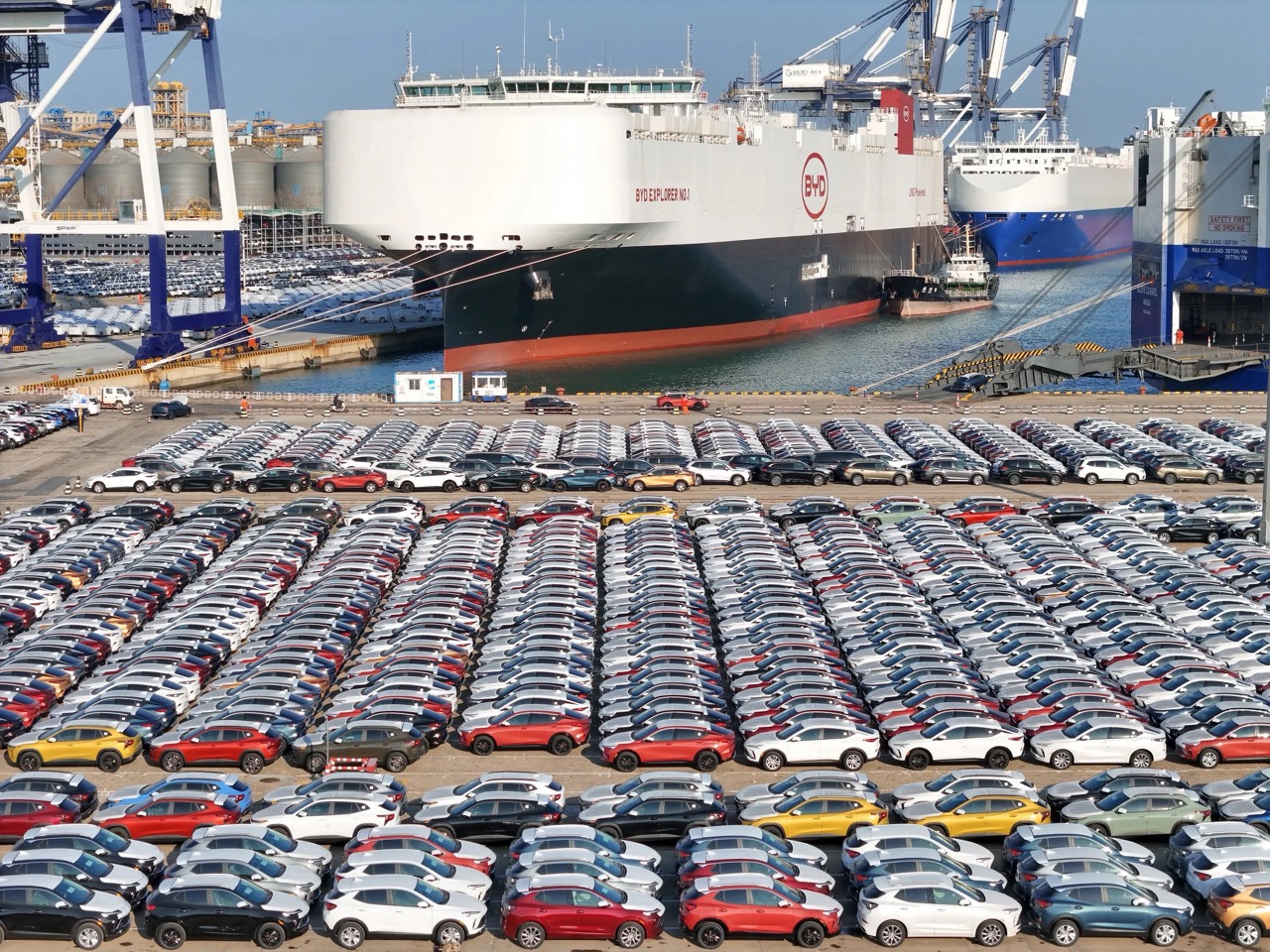
While China’s warehouses, docks, stations, airports, and factories are rapidly advancing unmanned operations, US ports have to cancel intelligent processes under union protests. Trump, in order to fulfill election promises to his stupid MAGA base, is restoring traditional energy while building a large number of backward industrial production lines. The goods produced by these factories can hardly be sold to any other country except under tariff protection in the US domestic market. For example, the US auto industry, their products not only have no competitiveness in the Chinese market but are also roughly made industrial garbage compared to Japan and Germany.
US tech giants have long monopolized technology and crazily exploited other countries. They also want to continue this model in AI technology. However, due to China’s existence, various open source large models are not much worse in performance than American commercial models. Other countries around the world can deploy their own AI services at very low costs. Doing so not only keeps data in their own country but also prevents their companies from building ecosystems on other countries’ infrastructure. Using American technology is extremely risky. ZTE was recently fined 1 billion dollars by the US government again. It has no choice but to pay, because 30% of its supply chain technology comes from the United States and must accept US government supervision. Ten years ago, it chose compromise, which doomed it to be threatened by Americans for life.

But Huawei refused the US government’s blackmail. It chose not to use American technology, not to sell its equipment in the United States, and not to use the American financial system. Huawei did not fall. On the contrary, it has developed into one of the most powerful companies in the world. Of course, ZTE is considered a large scale and technologically advanced company in any country. Its inability to confront the United States means most companies do not have this capability. Most countries have no ability to resist US sanctions. Therefore, when the AI technological revolution arrives, absolutely do not build your ecosystem on the closed infrastructure of Americans. Embrace open source and use Chinese AI technology. Otherwise, all prosperity is a castle on the sand. As long as the US government wants, Americans can easily take away your wealth at any time.
In this China US technology war, China does not need help from any country in the world. Everyone can remain neutral, take out beer and snacks, and watch the contest between China and the United States. I can bet a pack of french fries that Chinese people will have the last laugh.