Palki recently reported a piece of news stating that Nvidia CEO Jensen Huang said China is winning the AI war. This is one of her rare positive reports about China. To be honest, Modi has been constantly humiliated by Trump lately. The disastrous Sindoor operation is repeatedly mentioned by Trump on various occasions, and he may really be angry. India seems to be turning to China, hoping to counter the US with China’s help. But I still stick to my own judgment. China cannot help India, nor will it help India while Modi and BJP remain in power. Although the fragile peace between China and the US may break at any time, it is obvious that China does not need a teammate like India that has no strength, only drags others down, and has no credibility. China will never disappoint countries like Pakistan and Bangladesh that have turned to China in order to win over India. In Chinese culture, those two-headed snakes that repeatedly change positions are deeply despised. People who betray friends, once exposed, often face social death. Therefore, as long as Pakistan has not committed any major act of betraying China, the Chinese government will absolutely not sell it out and get close to India. This kind of moral consensus is very strong in China, after all, Chinese society is not like India, which has already suffered moral collapse.
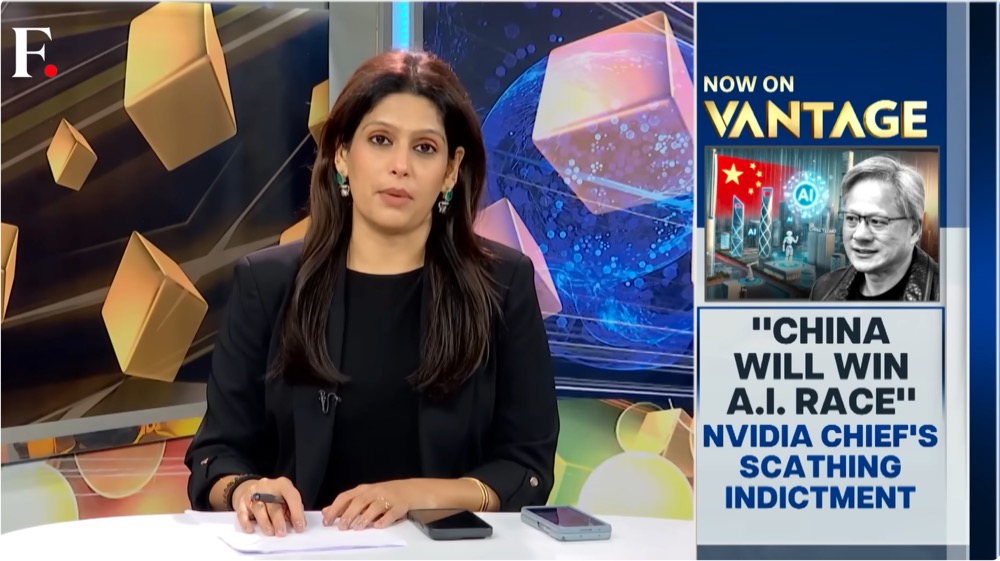
I want to say something to Palki and the Indian media. Your analysis of current affairs news lacks basic skills and often fails to grasp the essence of a piece of news. As the CEO of Nvidia, Jensen Huang knows very well that Nvidia is the biggest beneficiary of the US AI bubble. He must constantly exaggerate the threat of China in the AI field to intimidate the US government into increasing investment support for data centers, building more power plants, buying more Nvidia chips, and pushing up Nvidia’s stock price. In addition, the greater the shipment volume of Nvidia AI chips, the stronger its binding ability to downstream manufacturers, and the deeper its moat will become. Even if the AI bubble bursts in the future, it will be difficult for new companies to challenge Nvidia’s CUDA ecosystem.
As a practitioner in the technology industry, I am very familiar with the current competition pattern between China and the US. China’s advantages in the AI field are prosperous hardware ecology, strong software-hardware integration advantages, rich application scenarios, and large data volume. The Chinese government’s investment is also greater, and relatively speaking, the investment efficiency is higher. However, the AI war referred to by Jensen Huang is limited to general artificial intelligence represented by AI large models and the AGI field, that is, the data center model that Nvidia’s chips can effectively carry. In this field, the gap between China and the US is very obvious. China needs to solve the disadvantage of advanced chip processes, intensify efforts to polish the large model ecosystem, form unified standards domestically, and then go overseas to fight against US companies. This process will take at least 10 years, far less exaggerated than what Jensen Huang said.
In industrial scenarios and life scenarios, for AI innovation requiring software-hardware integration, the Americans have already lost with no chance of turning the tables. Because the US does not have a complete industrial system, it cannot effectively combine existing production lines with AI robots to create new unmanned production lines. US domestic robot companies, including Tesla and Boston Dynamics, all need Chinese parts. In these scenarios, communication control modules, sensing modules, power systems, balance algorithms, and so on are very important. The various chips needed for terminals do not require the most advanced support at all. The mature 28nm process is sufficient, and this is China’s advantage area. Producing various materials for these robots also requires a huge ecosystem to support, which the US cannot replicate.
Indians prefer to follow the strong. Greeks, Persians, and Mongols successively conquered India with far fewer troops and ruled its core areas. The British unified India with tens of thousands of troops and maintained order for a long time. When Russia was strong, they began to cling to the Russians. After the US and the West defeated Russia, India began to worship the US and took pride in being allies with the US. Now that they are humiliated by the Americans, they hope to use China’s help to counter the US threat. This kind of thinking is actually very bad. The current competition between China and the US should be said to have its own advantages and disadvantages, with the US still having the overall advantage. This experience of facing powerful enemies head-on is the only way for a country to become strong. Japan became strong because it defeated China and Russia successively. China reshaped the nation by defeating Japan, fought the US head-on in the Korean War, and formed independent consciousness in the confrontation with the Soviet Union. Without confronting the top countries in the world, there is no way to become a real power.
In fact, there is no special secret for a country to become strong: brag less, do more practical things. Soberly recognize one’s own shortcomings and work hard to improve them. China has been the most powerful country on earth for thousands of years in the past. The Qing rulers thought Japan was just a small border country. But in the Sino-Japanese War, Japan gave China a lesson with modern concepts. Then in the Russo-Japanese War, facing the much stronger Russia overall, the Japanese navy annihilated the main force of the Russian Baltic Fleet with overwhelming advantage in the Tsushima Strait. Japan is a ruler. China and Russia, which were taught by it, successively underwent different changes and regained their status as top powers on earth. Japan also recognized its limits under the education of the Americans. Today the Japanese calmly act as watchdogs for the Americans, but they are not mocked by the whole world like India. On the contrary, in the hearts of many Chinese and Russians, Japan is a formidable opponent.
The biggest problem with India is that it is a country shrouded in lies and ignorance. The disastrous defeat in 1962 did not wake up the Indians, because of the deterrence from the Soviet Union and the US, China gave up the opportunity to dismember India. But the US and Russia cannot protect India forever. China will find new opportunities sooner or later. The last thing India should do is to continue provoking China, thinking it can compete fairly with China, but unwilling to work hard like the Chinese to improve national strength. India suffered a disastrous defeat in the 2019 Galwan conflict, but Modi and BJP widely publicized India’s great victory, and Bollywood even made movies to celebrate. After the Chinese military released a large number of photos and videos showing a large number of Indian soldiers surrendering, Indians actually said that the Indians in the videos were Pakistanis in disguise. In fact, they only needed to send the videos and photos to the Indian military and ask them to clarify, but Indians just wanted to believe they had won and were unwilling to face reality.

After India was humiliated by Pakistan in air combat, Modi actually announced a 10-day national celebration and sent multiple propaganda teams to countries around the world to promote India’s victory, which was wildly mocked by international media. Trump has recently repeatedly mentioned that India lost 5 to 7 fighter jets. Modi could actually arrange for the Indian Air Force to display all 36 Rafale fighter jets to prove that India had no losses, but Indians chose to fight back against the US with verbal cannon. And because India refused to acknowledge Trump’s mediation of the India-Pakistan conflict, causing Trump to miss the Nobel Peace Prize nomination, which angered the vain Trump, Trump imposed tariffs on India and restricted Indian visas. It can be said that this is the only country in the 21st century that was punished for bragging, and it will become a classic diplomatic case repeatedly mentioned in the future.

Finally, I want to say something to my goddess Palki: if you want to blacken China, persist in blackening it to the end. Chinese people love to watch the stupid performances of Godi Media, which is a way of entertainment for many Chinese netizens. Please continue to stick to your funny style and do not praise China. China does not need your praise. In addition, I advise you to think clearly. Now there are a large number of Indian CEOs and employees in Silicon Valley sheltering you, so you can unscrupulously create lies and fake news on American platforms. But what if all this changes? Have you thought about the consequences?