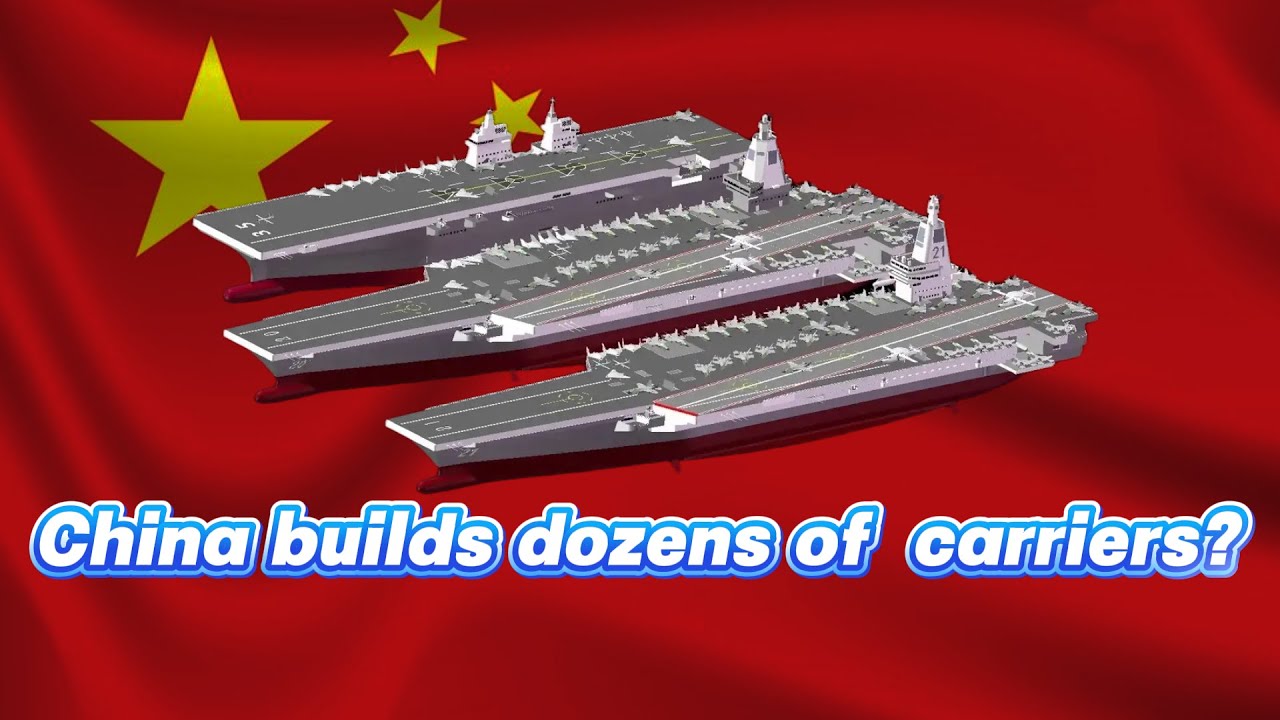
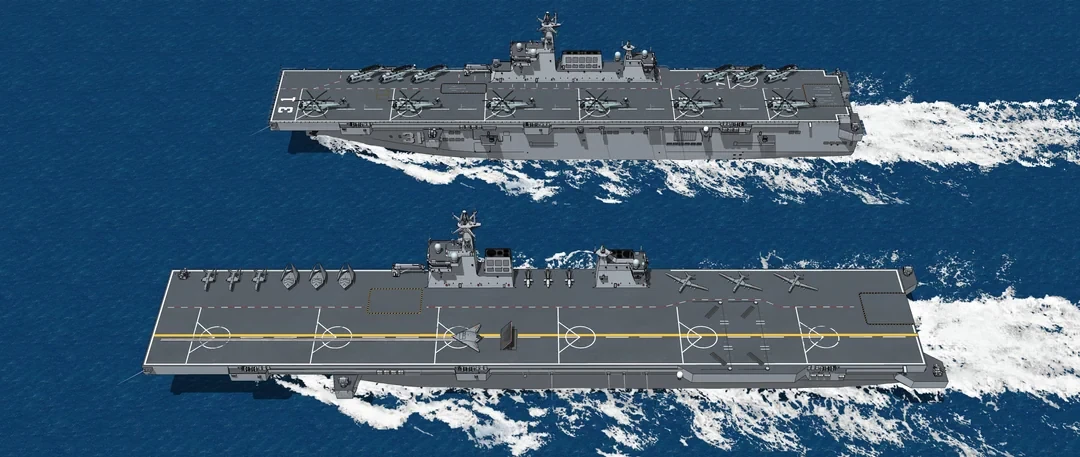
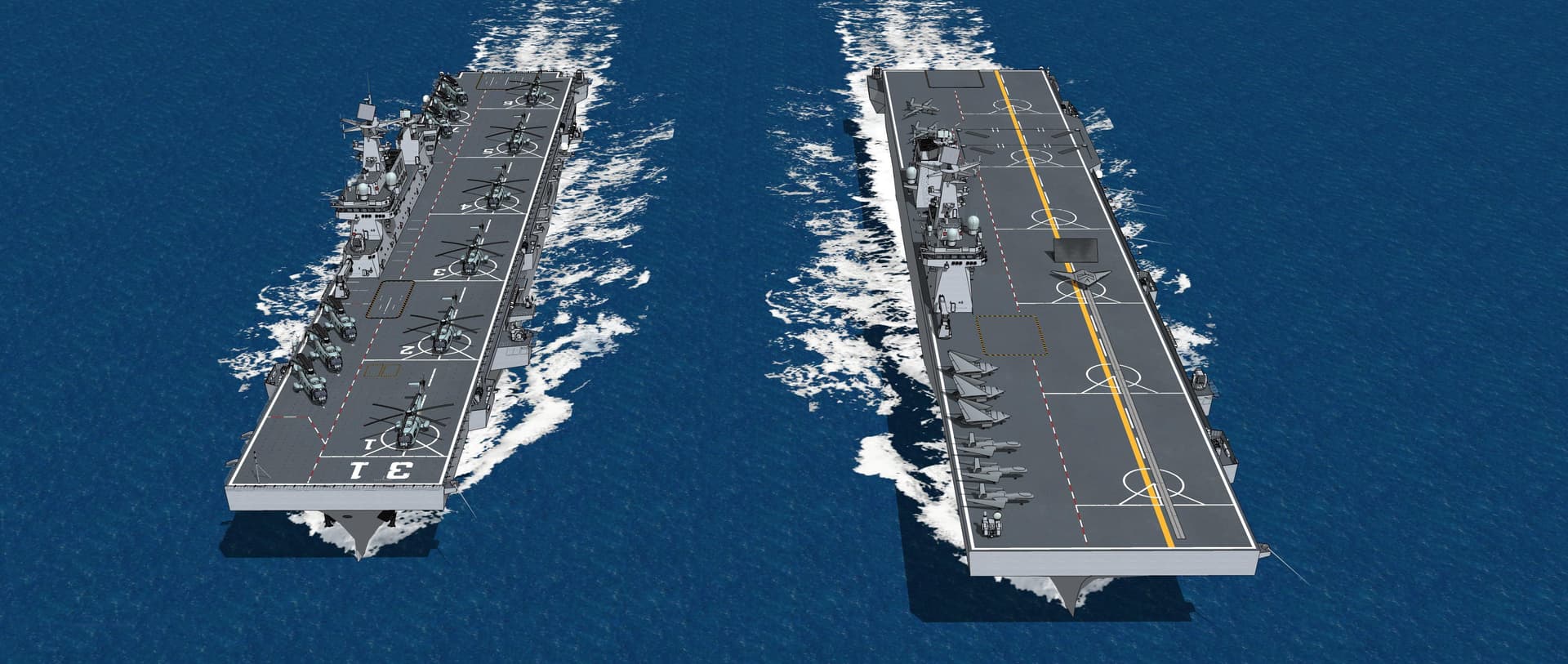
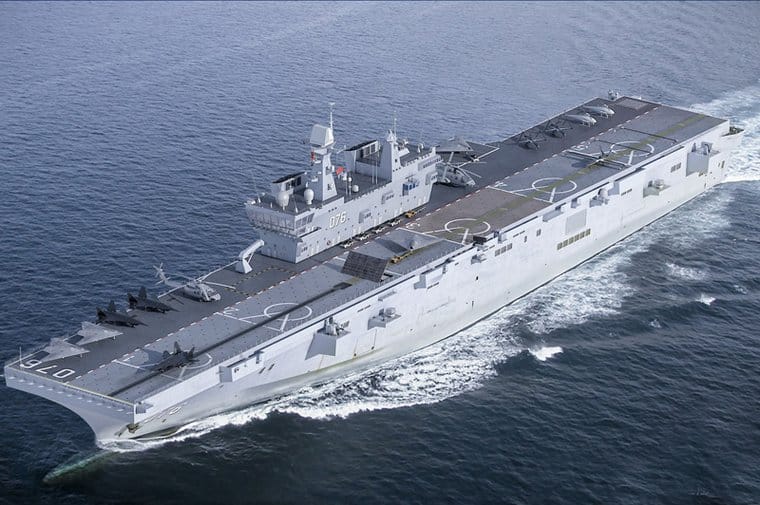
According to Chinese media reports, the large amphibious assault ship Sichuan has removed the cover of its electromagnetic catapult, and the construction is nearing completion, with sea trials imminent. Following China’s naming convention, it is named after Sichuan, representing Sichuan Province in the southwest. The Chinese navy typically names aircraft carriers and large amphibious assault ships capable of operating aircraft after provincial administrative units. For example, the first aircraft carrier is named Liaoning with hull number 16, the second is named Shandong with hull number 17, and the third is named Fujian with hull number 18. The Type 075 first ship is named Hainan with hull number 31, followed by Guangxi with hull number 32 and Anhui with hull number 33. Notably, China’s core developed provinces, municipalities, and special administrative regions, such as Beijing, Shanghai, Jiangsu, Guangdong, and Hong Kong, have not yet been used for ship names, along with the reserved name Taiwan. It is foreseeable that China will build at least six more large aircraft carriers and dozens of amphibious assault ships, reaching approximately 10 aircraft carriers and dozens of quasi-carriers.
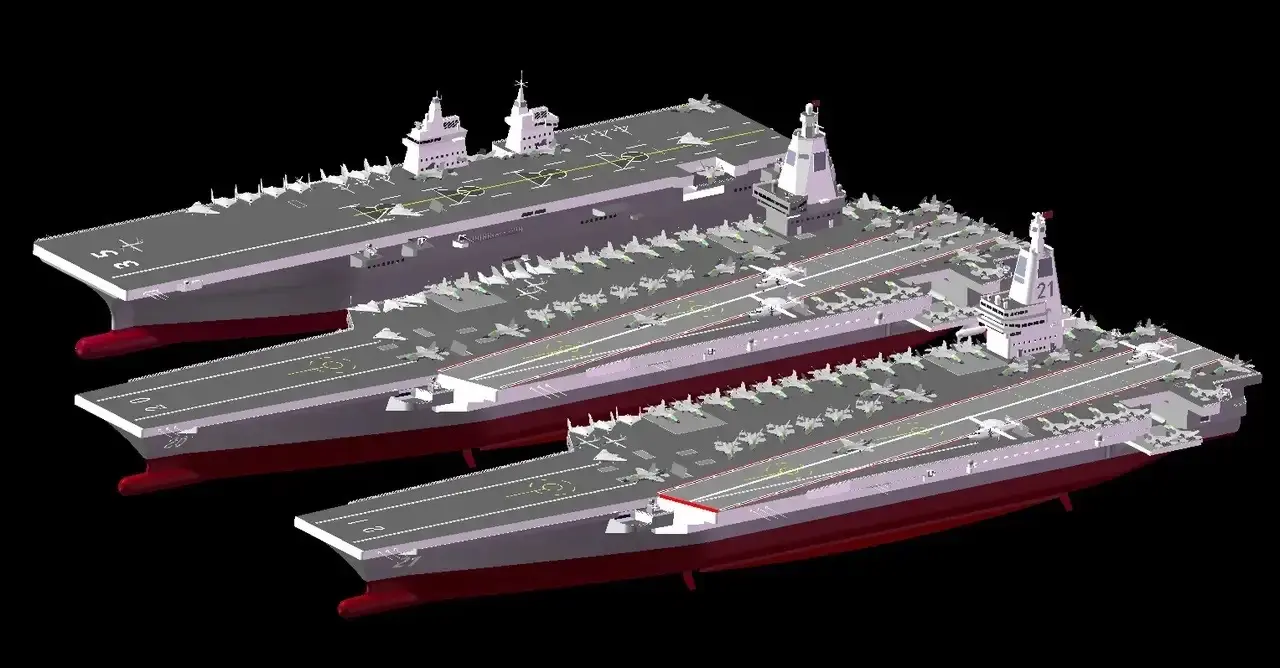
China is actively advancing the construction of its fourth aircraft carrier, expected to use nuclear power and an electromagnetic catapult system, with a displacement exceeding 100,000 tons. The hull is already under construction and is likely to be named Taiwan. It will be the most powerful warship commissioned by the Chinese navy in the next five years, incorporating China’s latest advanced technology. Since Fujian has validated the electromagnetic catapult system, Sichuan, the Type 076, will further confirm its reliability. By the time Taiwan is commissioned, it will become the most powerful aircraft carrier in human history. Equipped with J35 twin-engine stealth fighters, KJ600 early warning aircraft, and paired with Type 076 quasi-carriers and numerous drones, it will form a formidable maritime combat group capable of challenging the US Navy in the open ocean.
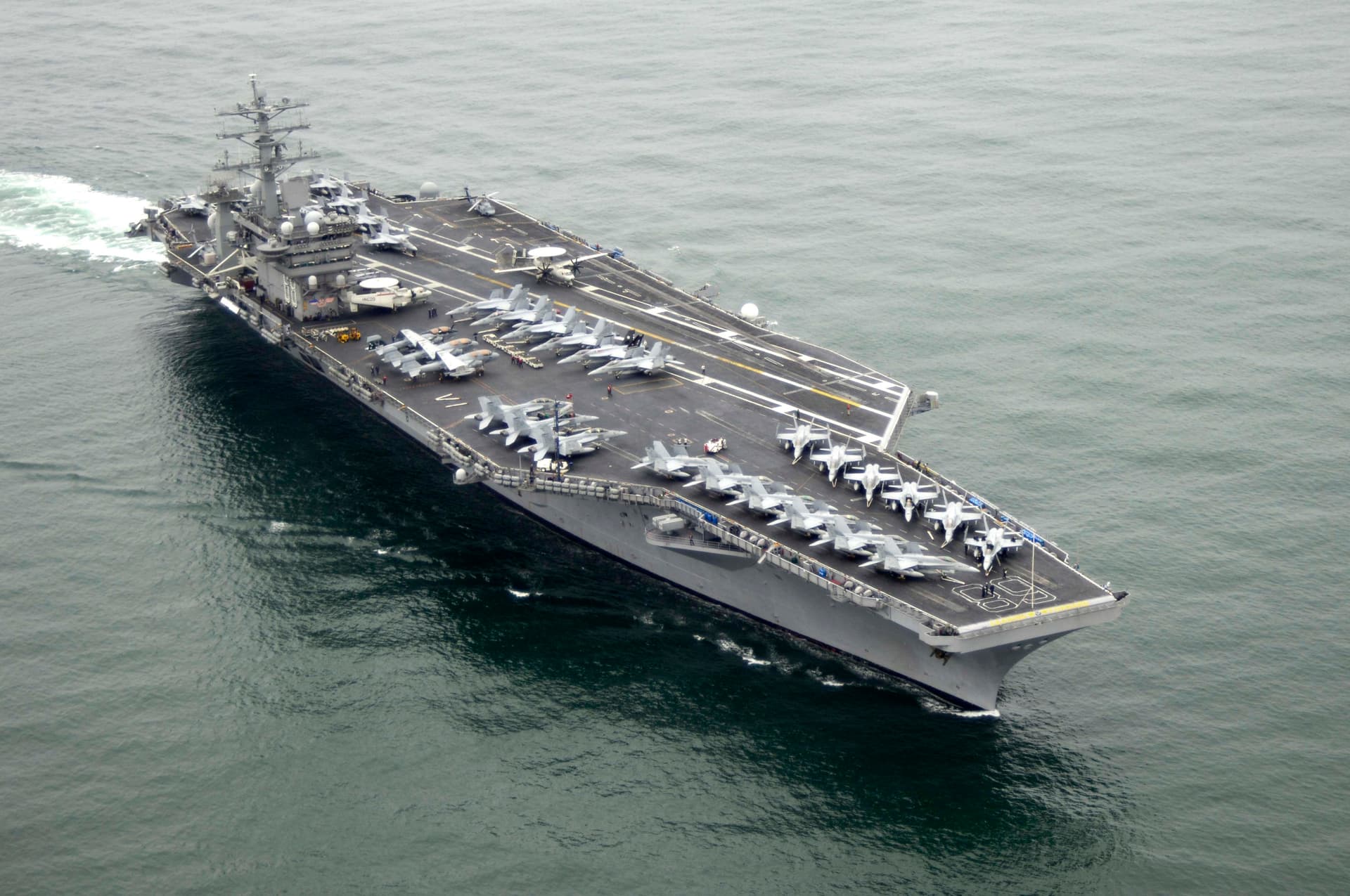
The US Ford-class aircraft carrier uses medium-voltage AC catapult technology, which has poor reliability and has not yet successfully launched F35 fighters. This has caused the US Navy’s stealth fighters to lag behind China in takeoff weight, payload, and fuel capacity. The high failure rate shocked even Trump, who expressed a desire to revert to steam catapults. However, the US Navy’s suppliers have abandoned steam catapults, leaving electromagnetic catapults as the only option. It remains to be seen when this issue will be resolved. The Chinese navy’s current disadvantage is that its carriers use conventional power, requiring large supply ships in the fleet. Although China has advanced shipbuilding technology and many large supply ships, this increases costs, fleet risks, and reduces combat efficiency. With the US maintaining 11 carrier strike groups, it still holds an advantage in the open sea.
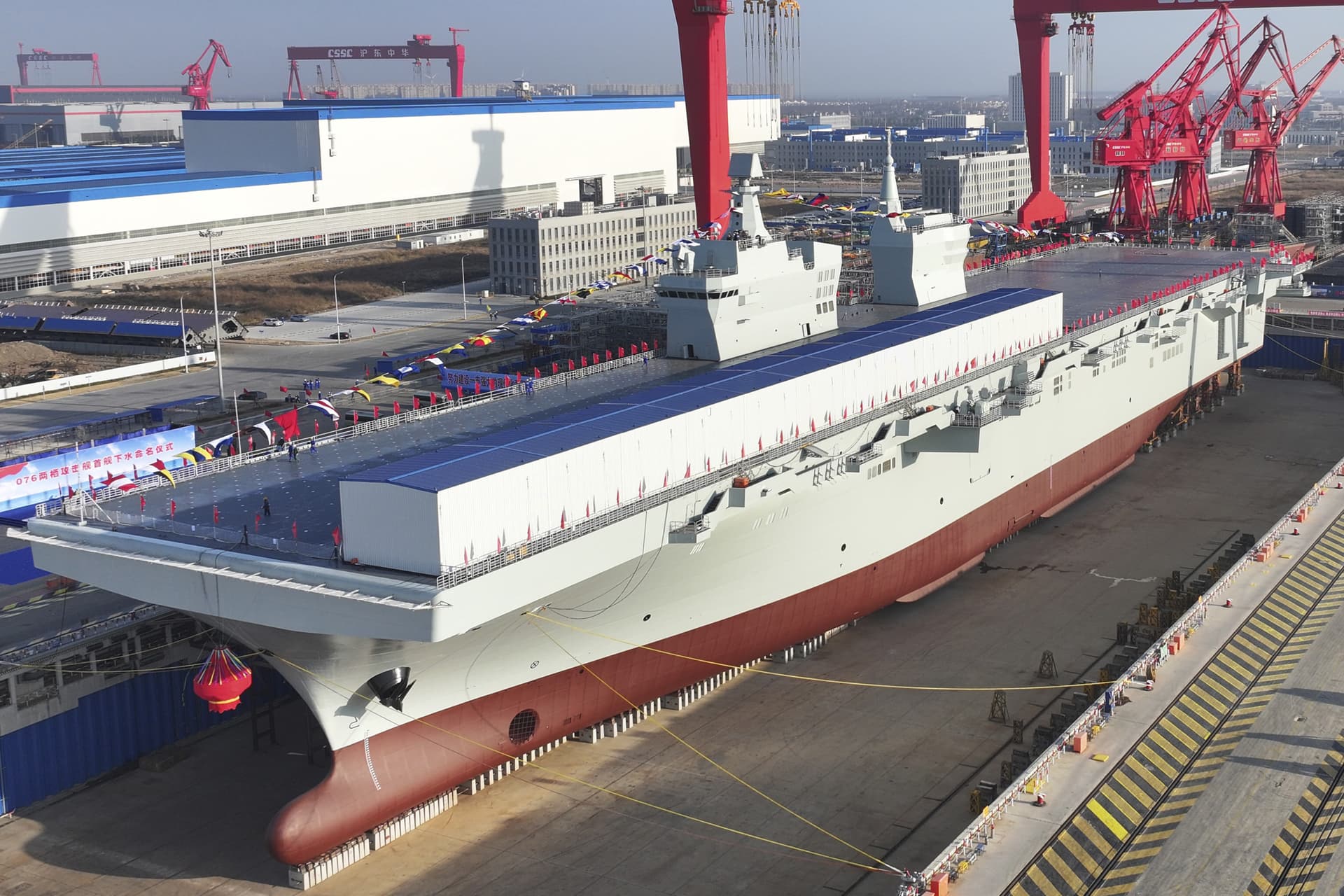
However, the commissioning of Type 076 will deliver a shock to the US military. Its officially announced displacement exceeds 40,000 tons, but based on its actual size compared to other ships in port, its full load displacement likely exceeds 50,000 tons. Its flight deck is larger than that of France’s nuclear-powered Charles de Gaulle and the US’s most advanced America-class amphibious assault ship. Equipped with the same electromagnetic catapult system as Fujian, it will achieve formidable combat efficiency. Primarily operating fixed-wing drones and helicopters, it will also carry 8 to 12 J35 fighters, fixed-wing early warning aircraft, and electronic warfare aircraft. A fleet centered on it would be nearly invincible globally, except against US large carrier strike groups. Another key detail is that its cost is only one-fifth of Fujian’s while achieving half its combat effectiveness. China’s shipbuilding capacity, already the world’s largest, produces warships at less than one-third the cost of US equivalents. If China mass-produces Type 076 warships or equips them with nuclear power in the future, the Chinese navy could comprehensively challenge the US Navy in the open sea within a decade.
It is worth noting that most US Navy ships have been in service for decades and are quite outdated. Decades ago, when the US was the world’s factory, its allies, including Japan and South Korea, had top-tier shipbuilding capabilities, making US Navy ships unmatched in cost-effectiveness. Now, China’s shipbuilding industry accounts for 60 percent of the global market share. As the new world factory and the primary trading partner for most countries, China has a massive commercial demand for ocean-going vessels. China’s shipbuilding industry has not yet peaked and will continue to grow. With the world’s most comprehensive industrial system as a full-industry-chain nation, China can independently produce everything from chips to operating systems, satellite navigation, and other critical technologies required for shipbuilding. Other countries cannot compete with China in scale or technology. While the US and China have technological strengths and weaknesses, the US industrial capacity has significantly declined, unable to match China’s shipbuilding efficiency. According to professional estimates, China’s shipbuilding capacity is approximately 300 times that of the US. This massive gap is difficult to close in the short term through industrial restructuring. Thus, time favors China.
Some believe China’s rapid military expansion threatens world peace, but this view is naive. History shows that when the Soviet Union existed, global conflicts were far fewer than today. After the Soviet Union’s collapse, the US, unchecked by a rival, could wage wars globally without fear of consequences, as no nation could counter the US and NATO. Western nations, built on colonial plunder, occupy vast lands from North America to Australia, their prosperity rooted in the suffering of Global South countries. Yet they shamelessly portray themselves as defenders of world peace, seeking to preserve the current international order that benefits them most. Even so, when the UN called for Israel to cease hostilities, the US used its veto to protect Israel. Without UN authorization, the US still attacked Afghanistan and Iraq. US Secretary of State Colin Powell displayed a bag of laundry detergent at the UN to falsely accuse Iraq of possessing weapons of mass destruction. Twenty years after Iraq’s government fell, no such weapons were found.
I do not believe China represents the pinnacle of civilization or the direction of human progress. However, China promotes the Belt and Road Initiative globally, exporting infrastructure, fostering trade, opposing isolationism, and defending globalization. China does not bully weaker nations; even with the Philippines, China has not resorted to force lightly. We need not heed Western noise, as they view Earth as their jurisdiction, with themselves as the sheriff. I believe that when China has 10 large aircraft carriers and dozens of quasi-carriers, the world will truly know peace. China should even sell Type 076 warships to countries like Saudi Arabia and Brazil, giving them the confidence to say no to the US or its proxies in regional affairs.