
Here is a detailed outline of the video:
I. Introduction to the Misconception about Semiconductor Energy Consumption
-
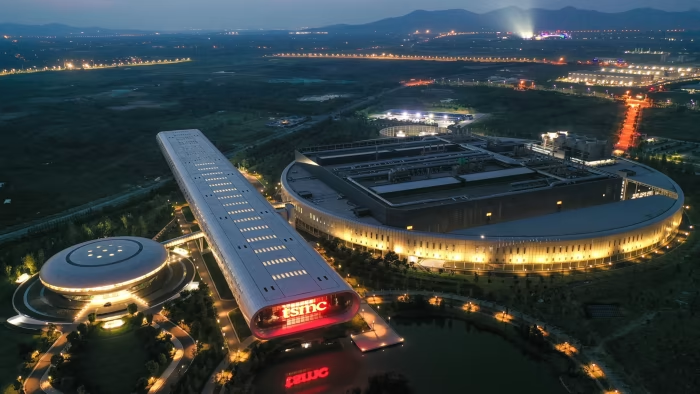
The video opens by highlighting the popular belief that the advanced manufacturing processes of semiconductor plants are the main consumers of electricity.
-
A report from early 2025 reveals that the energy consumed by the manufacturing machines accounts for less than half (46.1%) of a semiconductor factory’s total electricity use.
-
The video poses the central question: Where does the other half of the electricity go?
II. The Real Energy Hogs in a Semiconductor Plant
-
A report by the Taiwan Technology, Democracy, and Society Research Center indicates that 53.9% of a factory’s electricity is used for utility systems that maintain the operational environment.
-
This is not a phenomenon unique to Taiwan; research from Environmental Science & Technology and the U.S. Lawrence Berkeley National Laboratory shows that manufacturing processes typically account for only 30-40% of total energy use, with utility systems consuming around 60%.
III. Breakdown of Utility Systems’ Energy Consumption
-
According to the Lawrence Berkeley National Laboratory, the largest energy consumers within utility systems are:
-
Air conditioning systems: 26% of total electricity.
-
Cooling systems: 20%.
-
Liquid production: 7%.
-
Water purification: 5%.
-
-
In Taiwan’s report, the single largest energy user is the chilled water system, which accounts for 25% of the factory’s total electricity consumption for air conditioning and cooling.
-
Large fans and pumps for air circulation and water also consume about 11% of the total electricity.
IV. Why Cleanroom Conditions are so Energy-Intensive
-
The video explains that the purpose of air conditioning in a semiconductor factory is not for human comfort but to ensure a stable and clean environment for chip manufacturing.
-
The three main reasons for high energy consumption are:
-
High Air Exchange Rate: Cleanrooms require 60 to 240 air exchanges per hour (or up to 600 in the strictest cases) to remove any dust particles that could ruin a chip. This is significantly higher than a normal office environment’s 2 to 10 exchanges per hour.
-
Extreme Temperature and Humidity Control: Cleanrooms must maintain extremely stable temperatures, typically between 22-24°C, with fluctuations as small as ±0.1°C to ±0.5°C for high-end processes. The control of absolute humidity is also very strict and energy-intensive.
-
Positive Pressure: To prevent outside contaminants from entering, cleanrooms must maintain a slightly higher pressure than the outside environment, similar to a slightly inflated balloon. This requires a constant influx of air, which is then conditioned, further increasing energy use.
-
V. Solutions Implemented by Major Semiconductor Companies
-
TSMC’s Cooling System Improvement:
-
TSMC developed a project to improve the cooling mechanism for its clean, dry compressed air (CDA) system.
-
Instead of using chilled water (at 12°C) directly for the entire cooling process, they now use warm recycled water (28-30°C) for initial pre-cooling.
-
This two-stage approach reduced chilled water usage by 80% and is expected to save over 100 million kilowatt-hours of electricity per year in their 12-inch wafer factories across Taiwan.
-
-
ASE Group’s (日月光) Energy-Saving Measures:
-
ASE partnered with Supermicro and Chunghwa System to implement liquid cooling directly on chips, which improves heat dissipation efficiency by transferring heat directly to the chilled water system instead of the air.
-
At its Kaohsiung K5 plant, ASE introduced an AI-powered control platform that uses big data analysis of 61 factors (including temperature, humidity, and production schedules) to predict cooling needs and optimize the operation of chillers.
-
They also replaced traditional chillers with magnetic levitation chillers, which use magnets to suspend the rotor, eliminating friction and doubling energy efficiency.
-
These initiatives have saved over 18 million kilowatt-hours of electricity per year at the K5 plant alone.
-
VI. Government’s Role in Promoting Energy Efficiency
-
The Ministry of Economic Affairs’ Bureau of Energy acts as a “fitness coach” for large electricity consumers, providing a “training plan” through the Energy Management Act.
-
Companies that use over 800 kilowatts of electricity must regularly report their energy usage and appoint an energy manager to monitor their consumption.
-
The energy-saving goals are tiered based on consumption: a 1% annual reduction for companies using 801 to 10,000 kilowatts, and a 1.5% reduction for those over 10,000 kilowatts.
-
The government also provides subsidies and grants to companies that invest in energy-efficient equipment, acting as a “protein bar” to accelerate their progress.
VII. Conclusion
-
The video concludes that while there is no simple answer to the question of whether Taiwan’s electricity supply is sufficient, it is clear that the semiconductor industry is actively addressing energy challenges.
-
By acknowledging the “elephant in the room”—the massive energy consumption of utility systems—the industry is finding innovative ways to improve efficiency and reduce its overall power usage.